

The Ultimate Guide to the Benefits of Automation for Small Business: Unlocking Efficiency, Cost Savings, and Growth
Estimated reading time: 15 minutes
Key Takeaways
- Automation streamlines repetitive tasks, freeing up valuable time for strategic work.
- Significant cost reductions are achievable through optimized labor, reduced errors, and better resource allocation.
- Enhanced accuracy and consistency lead to fewer mistakes, protecting reputation and improving compliance.
- Automation provides a crucial foundation for sustainable growth, allowing small businesses to scale without proportionate increases in overhead.
- The Return on Investment (ROI) extends beyond immediate savings to long-term gains in customer satisfaction, data insights, and employee engagement.
Table of Contents
- Key Takeaways
- Unlocking Growth – Why Small Businesses Need Automation
- I. Understanding the Core Advantages of Business Automation
- II. Supercharging Efficiency and Boosting Productivity
- III. Reducing Costs and Minimizing Errors
- IV. Paving the Way for Sustainable Growth
- V. Quantifying the Investment: Automation ROI for Small Business
- VI. Real-World Inspiration: Automation Case Studies Small Business
- Conclusion: Your Path to a More Automated, Prosperous Future
- Frequently Asked Questions
Unlocking Growth – Why Small Businesses Need Automation
Running a small business is an exciting journey, but it also comes with big challenges. Imagine trying to juggle many balls at once: keeping track of money, finding and keeping great team members, attracting new customers, and staying up-to-date with the latest technology. These are just some of the intense pressures small businesses face every day, especially when it comes to time, money, and helpful people.
Many small and medium-sized enterprises (SMEs) often struggle with important tasks like managing cash flow, keeping good employees, finding new clients, and keeping up with how fast technology changes. It’s a lot! When there are too many tasks that are the same and need to be done by hand, it can make a small team feel overwhelmed. This stops them from focusing on bigger, smarter ideas that truly help the business grow.
This is where automation comes in. Think of it not just as a fancy new tool, but as a powerful secret weapon for your business. It’s a smart way to make daily jobs easier, cut down on extra costs, and use your team’s skills in the best possible way. Automation lets your business run smoother and smarter.
In this guide, we will dive deep into the many significant benefits of automation for small business. We’ll show you exactly how automation can help you become much more efficient, reduce your running costs, make fewer mistakes, and open the door for your business to grow steadily and successfully. By the end, you’ll have a clear picture of the real results, how much you can gain from your investment (we call this ROI), and the true value of bringing automation into your small business.
(Research: Small businesses operate in an increasingly competitive and dynamic environment, often grappling with significant pressures on their most valuable assets: time, resources, and budget. Research consistently shows that small and medium-sized enterprises (SMEs) face challenges such as managing cash flow, retaining employees, acquiring new customers, and keeping up with technological advancements. In this context, automation emerges not just as a convenience but as a powerful strategic advantage. It allows small businesses to streamline operations, reduce overheads, and allocate human capital more effectively. Reputable sources like Forbes and the Harvard Business Review frequently highlight automation as a critical tool for businesses of all sizes to enhance efficiency, reduce costs, and foster innovation.)
I. Understanding the Core Advantages of Business Automation
Before we go deeper, let’s make sure we understand what business automation really means for a small company. Simply put, it’s about using technology to do regular tasks or steps in your business without needing a lot of human help.
Imagine tasks that you do over and over again. Automation means you teach a computer program to do those tasks instead. This can be something as simple as an email program automatically sending a “thank you” message after someone signs up for your newsletter. Or it could be a bigger system that connects different computer programs to manage your workflow, keep track of customer information, or count your products in stock. The main idea is to take boring, manual steps out of your daily work and let software handle them reliably and quickly.
The many great advantages of business automation for small businesses are very important and have a big impact. At its heart, automation lets small businesses work “smarter, not harder.” It’s about using clever tools to get more done.
Here are the main benefits that experts in the business world often talk about, according to studies by groups like McKinsey and Deloitte:
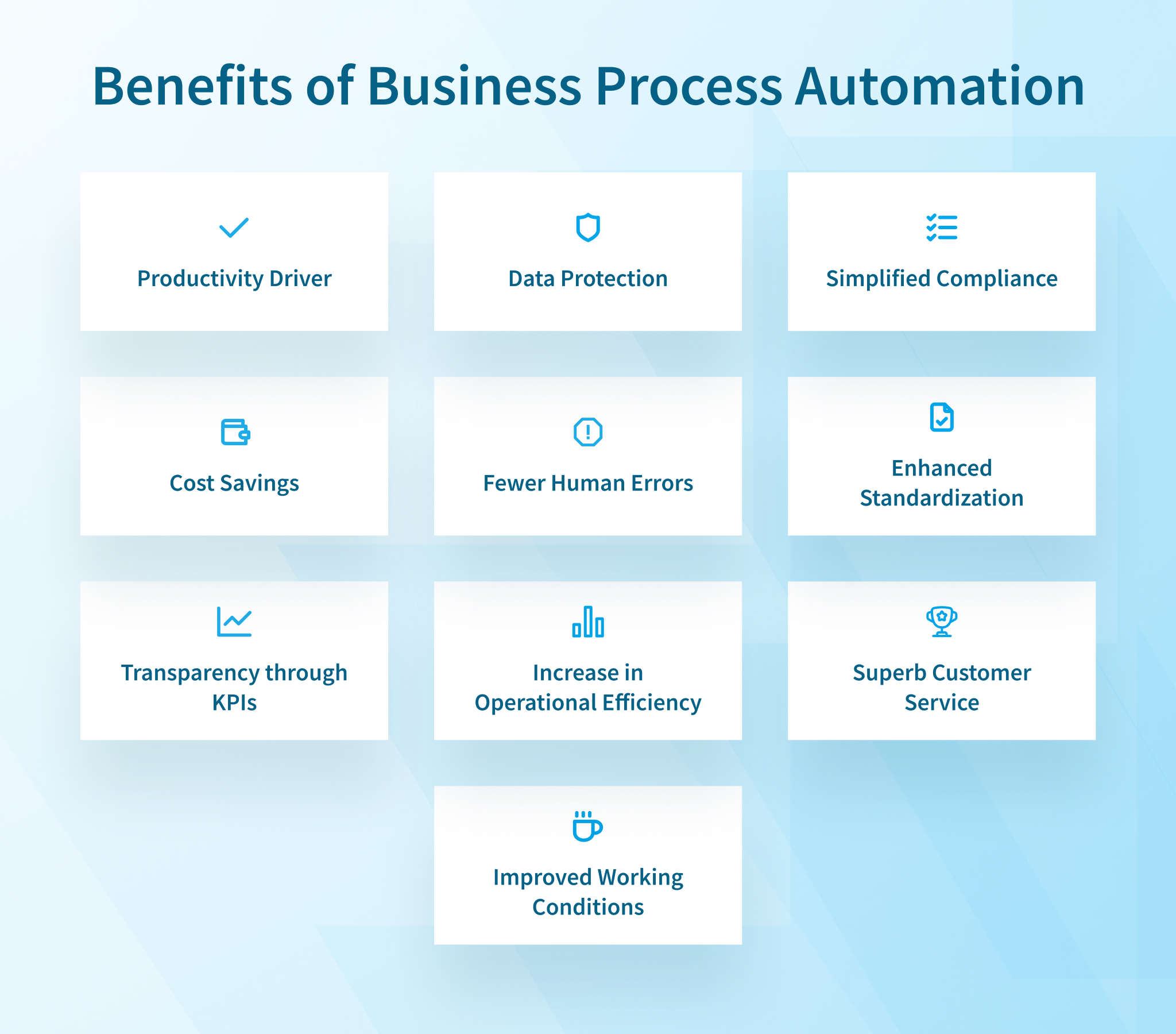
- Increased Efficiency and Productivity: When computers handle the dull, repeated tasks, your team members are free to do more important work. They can use their creativity, solve tricky problems, and build stronger relationships with customers. This makes everyone more productive.
- Cost Reduction: By making tasks run smoother and needing less manual work for jobs that are done over and over, businesses can spend much less money on their daily operations. This means more savings for you.
- Enhanced Accuracy and Reduced Errors: Machines are great at doing things exactly the same way every time. This means fewer mistakes when putting in information, doing calculations, or following steps in a process. Goodbye, human errors!
- Improved Scalability: Automation builds a strong base for your business to grow. It helps you handle more customer requests or expand your business without needing to hire lots more people or buy tons more things. Your business can stretch without breaking.
- Better Customer Experience: When things are automated, customers get faster replies, messages that feel more personal, and service that runs smoothly. All these things make customers happier and more loyal.
- Greater Data Insights: Automated systems are fantastic at collecting and looking at information. This gives you clear and useful facts that help you make smarter decisions for your business’s future.
These many advantages together prepare us to look more closely at specific areas where automation truly changes things for small businesses.
(Research: The overarching advantages of business automation for small businesses are multifaceted and impactful. At its core, automation enables small businesses to operate “smarter, not harder.” Key benefits frequently cited by industry experts and reports from sources like McKinsey and Deloitte include: Increased Efficiency and Productivity; Cost Reduction; Enhanced Accuracy and Reduced Errors; Improved Scalability; Better Customer Experience; Greater Data Insights.)
II. Supercharging Efficiency and Boosting Productivity
Automation is like a powerful engine that directly leads to more efficiency and higher productivity. These two things are often the biggest challenges for small businesses. Let’s explore how automation tackles them.
A. How Automation Saves Time in Business
One of the most immediate and clear benefits of automation for small business is how much time it saves. Think about it: by letting machines do all those boring, manual jobs, businesses get back precious employee time. This time was once spent on simple, administrative tasks.
Here are some real-life examples of how automation helps save time across different parts of your business:
- Data Entry: Imagine all the information you type from one place to another – from a sales sheet to your customer list (CRM system) or into your billing software. Automation can do this automatically! It transfers information between systems, cutting out hours of manual typing and potential mistakes.
- Report Generation: Do you need weekly sales reports or monthly marketing summaries? Instead of someone spending time gathering all the numbers, automated systems can pull data from different places, put it into a report, and send it to you on a schedule. This means you get important information quickly without anyone lifting a finger.
- Scheduling and Appointment Booking: If you manage a lot of appointments, you know how much time is spent sending emails back and forth to find a time that works for everyone. Automated booking systems (like Calendly or Acuity Scheduling) handle your calendar, send out reminders, and even help reschedule appointments. This greatly reduces the administrative back-and-forth.
- Customer Follow-ups: After a customer buys something, signs up, or even leaves items in their online shopping cart, you might want to send them messages. Automated email sequences can send welcome emails, ask for feedback, or remind customers about their abandoned carts. This ensures consistent contact without you having to remember to do it manually every time.
- Social Media Posting: Managing social media can be a big job. Tools that schedule posts (like Buffer or Hootsuite) let you plan all your social media content for the week or month ahead. The tool then posts them automatically to different platforms, saving your marketing team a lot of time each day.
By taking these time-consuming tasks away, businesses get back countless hours. These hours can then be used for important things like thinking about big strategies, spending more time helping clients, or solving bigger problems that truly matter.
B. Improve Efficiency with Automation
Automation does more than just save time; it fundamentally helps to improve efficiency with automation by making entire processes smoother. It reduces points where work gets stuck (bottlenecks) and makes everything move faster. When tasks are automated, they follow a set of rules, making sure they are always done the same way and very quickly.
This has a deep impact on how smoothly your business runs and how fast you can respond to things:
- Reduced Bottlenecks: Imagine a line of cars on a highway – a bottleneck. In business, manual approvals or transferring data by hand often cause these delays. Automation makes sure tasks move from one step to the next without waiting for someone to manually push them along.
- Accelerated Workflows: Processes like finding out if a new customer lead is good, packing and sending orders, or sending out bills all become much faster when automated. This leads to quicker service for customers and helps money flow into your business sooner.
- Consistent Execution: Every automated task is performed exactly the same way, every single time. This means fewer differences in how things are done and ensures that all steps follow your company’s rules and quality standards. You get reliable results every time.
- Enhanced Responsiveness: Automated systems can instantly react to certain situations. For example, if a customer asks a question online, the system can automatically create a support ticket for your team. If your inventory is low, it can automatically trigger an order for more supplies. This makes your service much quicker and more responsive.
This is where workflow automation benefits truly shine. They create a smooth and optimized way of working, where tasks flow easily from one to the next. This cuts down on wasted effort and makes your entire business much more productive.
C. Increase Productivity Small Business
The combined effect of saving time and making things more efficient results in a clear increase in productivity for small businesses. This is a powerful change that reshapes how your team works.
Automation lets your employees stop doing boring, low-value jobs (like repetitive administrative tasks) and instead focus on important, high-value work. This means they can use their talents where they matter most.
Here are examples of the high-value work your employees can dedicate their energy to:
- Innovation and Creativity: Instead of filling spreadsheets, your team can spend time thinking up new products or services, brainstorming exciting marketing campaigns, or finding better ways to run the business. This sparks new ideas and keeps your business fresh.
- Customer Relationships: Employees can spend more quality time talking to clients, truly understanding what they need, and giving them personalized help. This builds strong bonds and makes customers want to stay with you.
- Strategic Planning: With less time spent on daily chores, your team can look at big picture things. They can analyze what’s happening in the market, plan how to grow the business, and make smart decisions that will help the company in the long run.
- Skill Development: Employees can use saved time to learn new skills and grow personally. This makes your team more skilled and better at adapting to new challenges, creating a stronger workforce.
This shift in focus means that your business can achieve more output with the same or even fewer resources. Employees also become more engaged and happier because their jobs are more meaningful and less boring. This empowers your small business to use its human talent for smart growth, rather than just keeping things ticking over.
III. Reducing Costs and Minimizing Errors
Beyond just making things more efficient, automation brings very important benefits to how you manage your money and the quality of your work. These benefits directly affect how much profit your small business makes.
A. Reduce Operating Costs with Automation
One of the most powerful benefits of automation for small business is its ability to significantly reduce operating costs with automation. This means real money saved in several important areas:
- Labor Costs: Automation can lessen the need for employees to work too much overtime. In some cases, it can even mean you don’t need to hire extra people just for simple office tasks that are done over and over. Automation doesn’t always mean cutting jobs; instead, it often means your existing team can be moved to do more important work. This makes sure you’re getting the most value from your team members and spending your money on labor wisely.
- Resource Allocation: Automated systems can also help you use other resources better. For example, a system could automatically order new supplies only when your stock is low. This stops you from ordering too much, which saves you money on wasted goods and storage space.
- Reduced Training Costs: When tasks are automated, you don’t need to spend as much time and money training staff on how to do those manual steps. The system just handles it, simplifying the training process for your team.
- Energy and Infrastructure Savings: In certain situations, automated systems can manage things like your office heating and cooling or how your computer servers run. This can lead to lower electricity bills and less wear and tear on your equipment.
- Elimination of Inefficiencies: Automation is great at finding and fixing problems that waste money. These problems might be things like doing the same work twice, losing important papers, or forgetting to follow up on things, which can lead to missed sales. Sources like Accenture often talk about how process automation directly helps cut down on how much a business spends to operate.
(Source: Accenture)
By smartly dealing with these areas where money is usually spent, automation directly helps small businesses make more profit and have a healthier flow of cash.
B. Reduce Human Error with Automation
It’s natural for people to make mistakes, especially when they are doing the same boring tasks over and over again. Automation fixes this problem by making sure things are done consistently and correctly every time. This really helps to reduce human error with automation.
This benefit has big and important results, preventing costly mistakes that could harm your business’s good name, lead to fines, or make you lose money:
- Data Consistency: When data is entered or moved by hand, it’s easy to make typos, mix up numbers, or have different versions of the same information. Automated data entry and transfer processes stop these mistakes. This means you always have reliable information to look at and make decisions from.
- Calculation Accuracy: Automated systems for things like financial calculations, sending bills, and running payroll remove the risk of math errors. This ensures all your numbers are correct, which is vital for your business.
- Process Adherence: Automation makes sure that every single step in a process is followed exactly. This stops people from skipping steps or doing things differently, which can cause problems with rules or quality control. You get a reliable outcome every time.
- Compliance: For businesses that have to follow very strict rules (like in healthcare or finance), automation makes sure that all the necessary checks and balances are done consistently. This lowers the chance of not following the rules and having to pay penalties.
- Customer Satisfaction: Correct order fulfillment, accurate billing, and clear communication prevent customers from getting annoyed. It stops returns and complaints that often happen because of human mistakes. PwC reports often show how automation helps make sure data is correct and rules are followed.
(Source: PwC)
Stopping expensive mistakes, problems with your data, and issues with following rules not only saves money but also protects your small business’s trustworthiness and keeps your customers happy.
IV. Paving the Way for Sustainable Growth
For small businesses that dream of getting bigger, automation isn’t just a tool to be more efficient. It’s a key building block for growth that lasts, helping them expand smartly and handle new challenges as they become more complex.
A. Scale Small Business with Automation
One of the most important benefits of automation for small business is its power to help scale small business with automation. Think about traditional growth: usually, if you get more customers, you need to hire more people and buy more things. This is like growing in a straight line.
Automation breaks this rule. It gives you the tools to handle much more work without having to hire tons more people or spend a lot more money on daily tasks. It’s like having a bigger engine without needing a bigger car. Reputable sources like Deloitte often say that being able to grow bigger (scalability) is a main reason why small and medium-sized businesses choose to use automation.
(Source: Deloitte)
Let’s look at how automation specifically helps your business grow:
- Handling Increased Demand: As you get more customer orders, questions, or more data, automated systems can process all of it quickly and smoothly. This stops things from getting stuck, which would normally mean you’d have to hire more staff. For example, an automated system for orders can handle thousands of orders just as easily as hundreds (as long as your computer systems can keep up). It does this without needing a human to type in details for each one.
- Standardized Processes: Automation makes all your work steps the same. This means that as your business grows, every new employee or new shop location will follow the exact same good, efficient procedures. This sameness is super important for keeping your quality high and your brand looking good, no matter how much you expand.
- Smoother Expansion: When you want to open in new towns or start selling new types of products, automated back-office tasks (like managing customer details, sending bills, or tracking inventory) free up your main team. They can focus on getting into new markets instead of getting stuck in boring paperwork.
- Future-Proofing: By putting money into automation, small businesses are building strong systems that can change and adapt to what the market needs tomorrow. It helps your business deal with growth and get through tough times better. This makes your business stronger and more competitive for a long time.
- Global Reach: Automation can help you work across different time zones and in different countries. It makes sure that work keeps going and messages keep flowing, even when your team is sleeping. This makes it easier for small businesses to expand around the world.
To sum it up, automation allows a small business to grow its ability to do work and reach more people without also growing its amount of office work. This makes expansion easier, more manageable, and in the end, more successful.
V. Quantifying the Investment: Automation ROI for Small Business
Now, let’s talk about the money side of things. Understanding the Return on Investment (ROI) for automation is super important for any small business thinking about this smart move. When we talk about automation ROI for small business, it’s not just about saving money right away. It’s about all the financial and operational gains you get in a bigger picture.
Return on Investment (ROI), when it comes to automation, is a way to measure how much money you get back compared to how much you spent to put the automation system in place and keep it running. It helps small business owners see if the money they put in upfront is worth it and to understand the long-term value.
A. Practical Ways to Evaluate Potential Financial Returns:
You can look at the possible money you’ll get back in a few practical ways:
1. Cost Savings Analysis:
- Labor Cost Reduction:
- Example Calculation: Imagine an employee spends 5 hours each week typing in data, and their hourly pay is $25. That’s $125 saved per week just from automating that one task! Multiply this by all the employees who do similar tasks and then by a whole year. You’ll see a big saving.
- Error Reduction Savings: Think about how much mistakes cost. Maybe it’s money spent redoing work, losing customers because of a mistake, or even paying fines. For instance, if fixing a manual billing error costs $200 and it happens 5 times a month, automation could save you $1,000 every single month just by preventing those errors.
- Reduced Overtime: If your team often works extra hours just to keep up, automation can make them more efficient during regular hours. This means less money spent on overtime pay.
- Resource Optimization: Automation can help you save money by reducing waste, making sure you have just the right amount of products in stock, or even lowering your energy bills (if the automation helps manage things like lights or air conditioning).
2. Revenue Generation / Growth Potential:
- Increased Sales/Conversion: If automation helps you follow up with potential customers faster or provides better customer service, it can lead to more people buying from you or coming back for more. You can then count the extra money you make from these new sales.
- Faster Sales Cycles: Automation can speed up how quickly you send out quotes, get approvals, and welcome new clients. This means you get paid for your services or products much sooner.
- Scalability for Growth: Estimate how much more money you could make by being able to handle a much larger amount of business without having to spend a lot more money to do it.
3. Efficiency Gains (Value of Time Saved):
While saving time directly helps lower labor costs, it also frees up your employees to work on big, important tasks that help your business grow or invent new things. Think about the value of a salesperson spending more time actually selling instead of doing paperwork. This redirected focus has a real, though sometimes harder to measure, financial impact.
B. Calculation Formula (Simplified):
Here’s a simple way to think about the ROI formula:
ROI = (Total Benefits – Total Costs) / Total Costs * 100%
Let’s break down what these terms mean:
- Total Benefits: This is all the money you gain over a certain period (like one year). It includes all the cost savings you found, the money saved by reducing errors, and any extra money your business made because of automation.
- Total Costs: This includes all the money you spent on automation. This means the cost of the automation software, any fees to set it up, money spent on training your team, getting it to work with your other systems, and any ongoing payments to keep it running.
C. Immediate vs. Long-term Financial Impacts:
It’s important to remember that automation can bring benefits at different times:
- Immediate Impacts: You might see these very quickly. They include direct savings on labor for specific tasks, getting paid faster because processes are quicker, and an immediate drop in errors that are easy to spot.
- Long-term Impacts: These benefits build up over time. They include things like your business being efficient all the time, customers staying with you longer (because of better service), making smarter choices because you have better data, and your business being more flexible. The biggest long-term benefit is being able to grow a lot without your costs growing as much. You also “future-proof” your business and improve how happy your employees are (which means fewer people leave, saving you money on hiring). These are all great long-term benefits, even if they are sometimes harder to put an exact number on.
By carefully looking at the ROI, small businesses can stop just guessing and start making decisions about automation based on real numbers. This makes sure they are truly getting good financial value from their investment.
VI. Real-World Inspiration: Automation Case Studies Small Business
Seeing how automation actually works for other small businesses can be truly inspiring. It shows you that these ideas aren’t just for big companies! Here are some clear examples, or stories, from different types of small businesses. They show the practical benefits of automation for small business in action.
A. E-commerce Retailer: “QuickShip Co.” (Automating Order Fulfillment & Customer Communication)
QuickShip Co. is a small online shop that sells handmade items.
- Challenge: The owner was spending 10 to 15 hours every week doing manual tasks. These included processing orders, printing shipping labels, sending confirmation emails, and updating how many products were left in stock across different online places. This led to slow deliveries and sometimes mistakes.
- Automation Solution: QuickShip Co. used a special connection platform (like Zapier or Make) to link its online store (Shopify) to its shipping company (like ShipStation), its email program (like Mailchimp), and its accounting software (like QuickBooks).
- Automated Workflow: Now, when a customer places an order on Shopify, the system does several things automatically: it creates a shipping label, updates the inventory count, sends a personalized email to the customer with tracking details, and records the sale in QuickBooks.
- Tangible Results:
- Time Savings: The time spent on manual order processing dropped from 10-15 hours to less than 2 hours per week. This freed up the owner to spend more time designing new products and marketing the business.
- Efficiency: Orders were packed and sent 50% faster. This meant customers got their items quicker and were much happier.
- Error Reduction: The system stopped mistakes that happened when typing in shipping addresses or counting products.
- Customer Satisfaction: Because customers automatically received shipping updates, QuickShip Co. got far fewer “where’s my order?” questions.
B. Professional Services Firm: “LegalAid Advisors” (Automating Client Onboarding & Scheduling)
LegalAid Advisors is a small firm that gives legal advice.
- Challenge: This firm had trouble with getting new clients set up because the process was not consistent. They also spent a lot of time manually scheduling meetings and chasing clients for missing documents. This made the client experience uneven and took up too much administrative staff time.
- Automation Solution: They adopted a Customer Relationship Management (CRM) system (like HubSpot CRM) that was connected to a scheduling tool (like Calendly) and a document management system (like Clio).
- Automated Workflow: When someone asks a question on their website, the system automatically creates a new potential client record in the CRM. This then triggers an automatic email with a link for them to book a consultation meeting using Calendly. Once a meeting is booked, another automatic message sends a questionnaire to fill out beforehand and a secure link to upload any needed documents. After the meeting, follow-up emails are sent automatically depending on what happened.
- Tangible Results:
- Client Experience: The smooth way new clients were welcomed, the professional emails, and the easy way to send documents all made clients feel better about the firm and more satisfied.
- Productivity: The administrative staff saved 8-10 hours each week. This time was previously spent on scheduling and reminding clients about documents. Now, they could focus on directly helping clients.
- Reduced Delays: Getting documents faster meant that client cases could begin sooner.
C. Restaurant/Cafe: “The Daily Grind” (Automating Inventory & Supplier Orders)
The Daily Grind is a busy local coffee shop.
- Challenge: The cafe struggled to manage its ingredients. This often led to running out of popular items or ordering too much food that would then go to waste. They also had to manually check and match supplier bills.
- Automation Solution: They linked their Point of Sale (POS) system (like Square) with an inventory management software. This software used sales information to guess how much of each ingredient they would need and automatically triggered new orders when stock levels got low. The inventory software then automatically sent purchase orders to their approved suppliers.
- Tangible Results:
- Cost Savings: Because inventory was managed better, they reduced food waste by 15%.
- Efficiency: Managers were freed from doing daily manual inventory checks and placing orders. This saved them 5-7 hours per week.
- Operational Smoothness: They almost never ran out of popular items, which meant their menu was always available and customers were happy.
- Accuracy: The system stopped mistakes in calculating orders, leading to more accurate budgeting.
These stories show that automation isn’t just for huge companies. It’s a real, accessible solution for small businesses in many different areas to make big improvements in their daily work and strategic growth.
Conclusion: Your Path to a More Automated, Prosperous Future
We’ve seen that the benefits of automation for small business are huge and truly change things. From saving you precious time and making everything much more efficient, to greatly cutting down your running costs and stopping expensive mistakes, automation gives small businesses the power to get past common problems and build stronger, more profitable operations.
It’s the engine that makes your team more productive. It allows your talented employees to focus on smart new ideas and building great relationships with customers, instead of getting stuck on tasks that are the same every day. Crucially, automation also prepares your business for lasting growth, giving you the tools to expand without a huge jump in overhead costs. This means you’re building a business that’s ready for whatever the future holds.
When you carefully look at the money you put in versus what you get back (your ROI), you’ll see that automation isn’t just an expense. It’s a smart investment that brings real financial gains, both right away and over a long period. As the real-world stories showed, businesses just like yours, in many different industries, are already using automation to get tangible results and a competitive edge.
In today’s fast-moving digital world, automation is no longer just a fancy extra for big companies. It’s an accessible and essential tool for small businesses to do well, create new things, and grow successfully. We encourage you to take a close look at how your own business operates. Find those tasks that you do over and over that eat up your valuable time and money, and start exploring the many easy-to-use automation solutions available.
Embracing automation isn’t just about making your business smarter; it’s about building a more efficient, cost-effective, and ultimately, a more prosperous future.
Frequently Asked Questions
What is business automation for small businesses?
Business automation involves using technology to perform repetitive tasks and workflows without significant human intervention. For small businesses, it means leveraging software and systems to handle routine operations, from data entry to customer follow-ups, making processes faster and more reliable.
What are the main benefits of automation for a small business?
The core benefits include increased efficiency and productivity, significant cost reduction, enhanced accuracy, improved scalability, better customer experience, and greater data insights for smarter decision-making.
How does automation save money for small businesses?
Automation reduces operating costs by cutting down on labor for repetitive tasks, minimizing human errors (which can be costly to fix), optimizing resource allocation (e.g., inventory), reducing training expenses, and eliminating inefficiencies in various processes.
Can automation help my small business grow?
Absolutely. Automation provides a scalable foundation that allows your business to handle increased demand without a proportional increase in costs or staff. It standardizes processes, simplifies expansion into new markets, and frees up your team to focus on innovation and strategic growth initiatives.
How do I calculate the ROI of automation?
A simplified ROI formula is (Total Benefits – Total Costs) / Total Costs * 100%. Total benefits include all cost savings (labor, error reduction, resource optimization) and any increased revenue. Total costs include software, setup, training, integration, and ongoing maintenance fees.